
[Note: I began writing this piece when I was 42 years old. I am no longer 42. I initially only shared it with family and close friends, but as the years have passed, it has become clear to me that it is time to share it with the world. It’s a long one but I figure if you’re reading this, you’re probably interested. My hope is that my journey would be helpful to others.]
“A hallmark of wisdom is knowing when it’s time to abandon some of your most treasured tools – and some of the most cherished parts of your identity.” – Adam Grant, Think Again, p. 18
I read the lines above a couple days after I started learning about autism in adult females and how it can show up differently from men (which is the demographic upon which most of our cultural and clinical understanding of autism are based on currently). The quote felt like an invitation for me to be open to how I understood myself. As I learned about autism, I realized I could very well be autistic.
Initial Objections
My curiosity about autism started when I read these two FAQ articles (here and here) from my friend, Heather Caliri. She had recently realized she was autistic and I found that I could relate to a lot of what she shared. She posted a site where you could take a self-test so I took it (this RAADS-R test is a reputable one). My results indicated that I had autistic traits. So, I took some more tests. They all came back indicating the same thing.
But how could it be???
I didn’t fit the idea of what I thought autism was. I had friends. I knew how to carry a conversation. I had a large social network. I didn’t have learning disabilities. I didn’t flap my hands or avoid eye-contact. I wasn’t a math genius. I was empathetic. As far as I could tell, I wasn’t obsessed with certain interests or always rocking back and forth.
And yet…
I answered a resounding yes to any question about sensory sensitivities and upon closer inspection of my life, a lot of the other markers were there. Turns out how I expressed (or suppressed) my inner experience made it difficult for the outside observer to tell that I was autistic.
This tendency was called “masking.” It’s an adaptation strategy that most people use to some degree or another. For neurodivergent folks (a term used to describe the way some people’s brains process information that is different from “neurotypical” brains), they use masking to adapt to socially accepted behaviours and basically pass for neurotypical people. In other words, they learn to ignore or cover up their natural tendencies or inner sensations and act in ways that allow them to blend in and function in a society not designed for them. The hidden danger is that masking costs the person in energy, self-knowledge and self-acceptance.
Unlearning Assumptions
My first thought was “Maybe I’m high-functioning autistic or on the low end of the spectrum.” As I read more about autism and the neurodivergent community, I learned that both “high-functioning” and “low end” are unhelpful and incorrect descriptions. Not only are they based in an ableist mindset that considers certain abilities as better than or more valuable than others, they don’t reflect the type of spectrum it is.
I came across this graphic from the artist Amanda Mc Guiness that gave me an aha moment:
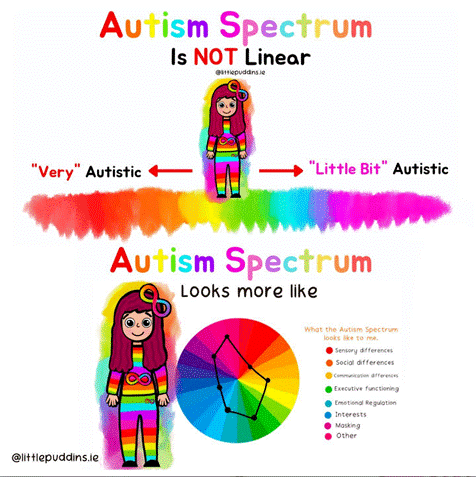
A better way of describing someone on the spectrum is by assessing their support needs. Using this description, I would fall under the category of someone who has low support needs.
To have an autistic brain is to process information differently. How it shows up in each individual is as varied as the individuals themselves. For some people, the expression of their differences will be more obvious while for others it won’t be as obvious. What can be observed from the outside does not necessarily reflect the person’s inner experience. A lot of the stories I read would quote the saying, “If you’ve met one autistic person, you’ve met one autistic person.” This was a bit hard for me to wrap my brain around but as I reflected on my own story and compared it to others’ I realized the truth of it.
The other assumption I had to unlearn was that autism is a disorder. I know clinically, the label given to this set of traits is called Autism Spectrum Disorder (ASD), but there are many who would argue that the word “disorder” misrepresents the experience. Disorder implies that something is wrong and needs fixing. But just because a brain processes differently, does it make it wrong and need to be fixed? Within the neurodivergent community, a more accepted term currently is Autism Spectrum Condition (ASC).
Some people also argue that autism isn’t something you have, like a cough or a stubbed toe. Autism describes an innate set of characteristics. It’s akin to introversion and extroversion. You don’t say “I have introversion,” you say, “I’m introverted.” It’s the same with autism. When seen in that light, it doesn’t make sense to need “diagnosis”.
Another thing I learned was that the term Asperger’s is no longer used. The term is linked to a person who was involved in eugenics with the Nazis and the set of traits it described has since been absorbed into the autism spectrum. However, there is still a lot of information out there that still uses this term. Actually, in researching adult female autism, I realized there’s a lot of outdated information out there, period. It seems we live in a time where researchers and the medical community are only starting to look into the non-white male autistic experience and recognize that it shows up very differently than what is currently accepted, which is why I made it to 42 years old without anyone ever mentioning the possibility of it to me.
My friend Heather whose blog post first tipped me into awareness of autism explained how autism is diagnosed. Many autistic traits are seen in non-autistic people, but the particular constellation of traits plus the degree to which it affects a person makes it fall under the category of autism. To be considered autistic, people must exhibit social struggles in three ways: trouble bridging social gaps, social confusion, and masking. They must also have three of four possible sensory differences: sensory sensitivity, stims (repetitive physical “self-stimulating” behaviours), a change-averse love for routine, and special interests. Autistics also are more prone to meltdowns and burnout because they expend so much energy trying to fit into society. According to author Dr. Devon Price, people can also show “sub-clinical” amounts of traits, meaning that they wouldn’t meet clinical thresholds but definitely still belong in the autistic community.
Autism also commonly occurs along with ADHD, which is called AuDHD. Because autistic traits are often opposite to ADHD traits, it may make it more difficult to recognize either since the traits can mask each other.
Early Evidence: Childhood
As I learned about autism, I found out that the neurological differences begin in early childhood. So, I thought back to what I know about how I was as a baby and what I remember of my childhood experience. I looked back with specific autism traits in mind.
From the get-go, I was a colicky baby. There’s no way to know for sure, but I do wonder if I cried so much because I experienced sensory overload even as an infant. As a kid, I found it easier to relate to adults than to other children because kids were loud and unpredictable. I also didn’t quite know how to play like other kids. I had a ton of stuffed toys but I mostly looked at them all lined up like a display and felt guilty for not playing with them. I remember trying to have a tea party once like I’d seen other kids do, but after I set it all up, I was confused as to what to do next.
I was slow to pick up reading and needed extra help but once I got it, I became a voracious reader. I was startled easily by unexpected noises (I still am) and found certain types of ballet tights too scratchy. Smells affected me a lot and most of my memories of my childhood trips to Hong Kong were its smells. I was probably bothered by a lot more but I learned to keep quiet about it and not make a fuss because the adults would get mad.
Mounting Evidence: Adolescence
Grades 6-8 were excruciatingly lonely years for me. I switched schools for Grade 6 and I found it extremely difficult to make friends. Consequently, I hung out either at the library or in the classroom helping my teacher during recess as a way to escape having to socialize. I found solace in excellence. I was top of my class at school and model Christian at church. I was not interested in pop culture; current trends, TV shows, music, movies, celebrities and fashion felt trivial to me. Instead, I read through the entire Sherlock Holmes collection and all of Agatha Christie’s books. I was a floater socially. I would get invited to things, but inside, I never felt like I belonged.
Adolescence was full of meltdowns. I remember crying a lot at home. Publicly, I only had a couple meltdowns (both times over things that were not perfect at school.) I regularly had stomach aches and constipation issues, and every March I would get majorly sick during Spring Break. Looking back, I understand these as symptoms of an overloaded and dysregulated nervous system.
More Evidence: Young Adulthood
A saving grace in high school was that I got into a Fine Arts program. This meant that I consistently started each day with art class and I got to know a smaller group of students in a school that had a population of over 2000 kids. It also meant that there were other neurodivergent people (because a lot of artists happen to be neurodivergent) so I didn’t feel quite as odd. In Grade 11, I was introduced to backstage theatre. I loved learning how all the tech worked and I quickly found a home there. Everyone was a little quirky and I felt cool because I got to access parts of the theatre that were restricted to most people.
I ended up choosing Theatre Set Design for my undergrad and continued to excel in school. One evening while I was working on a project in our design studio, my classmates were joking around about what our Spice Girls names would be if we had them. The name they gave me was, “Precise Spice,” because my work was always so meticulous.
I pushed myself really hard. I was involved in a lot of things and expected excellence from myself on all fronts. I would go super hard and then crash. Some days I would work for 14 hours straight. Other days I would sleep for 14 hours straight.
I never quite knew what to do about relationships with the opposite sex. I felt confused about their intentions and unsure of what was appropriate. I was mostly afraid of guys and despite agreeing to hang out with them, I would feel uneasy the whole time.
I continued to follow all the rules at church and decided to become a missionary – after all, I was sold the idea that this was the best thing I could do with my life to make it count for God. I didn’t know enough about myself at the time, but moving to a gigantic city overseas and having to operate in a new language would overwhelm me and probably be as close to a living nightmare for me as anything could be. It resulted in me experiencing major burnout at the age of 27.
Until I started dating Tim, I didn’t realize I had very little awareness or vocabulary for my emotions. He would ask me, “How do you feel?” and I would stare at him blankly. I also felt guilty for sometimes being so focused on tasks and not caring for people enough.
Present Day
My lifestyle now accommodates my needs a lot better than my growing up and young adult years. As a result, my stomachaches have mostly subsided. I spend most of my time in our quiet home and only head out for groceries or appointments during the week. Even for groceries, I try to order them online, if possible, to avoid having to wander around the store. If I have the capacity, I will go to church.
I have a lot of sensory sensitivities that I have to work around, including heightened sense of smell (sorry to any friends who have gifted me scented candles, soaps, or lotions…), my skin being allergic to the sun, extra sensitive hearing, and being particular about the fabrics I wear. My poor husband has to put up with me limiting his hair gel choices to smells I can tolerate. Buying shoes feels like a holy grail.
Socially, I now have an amazing group of supportive friends. We’ve realized that many of them are neurodivergent themselves. It’s much easier for me to communicate by text than by phone as I have more time to articulate and process my thoughts, particularly as I’ve discovered I have auditory processing struggles (which is also a common co-occuring condition with autism). I need subtitles when I watch movies or videos. My ability to pick up on sarcasm has always been hit and miss and I often take things literally.
I’m particular about where things are kept in my home and get distressed when they’re out of place (the one main exception is my desk which is a depository of unmade decisions – this is partly executive function challenges due to some ADHD tendencies). I have a morning and bedtime routine that I like to stick to. It irks me when my floors or bathrooms are dirty. Driving and shopping are highly stressful and energy draining. I rely on family members to take my kids out to activities and lessons.
I’ve learned that my “stims” are more subtle than rocking my body or flapping my hands. I will do things like pick at my skin, twirl my hair, or run my tongue along my teeth instead. I used to think I did those things out of anxiety but now I know it fills a need for my nervous system. I also sit in weird positions, often with my knees tucked up. I haven’t met a comfortable chair yet. (This last part, I’ve since learned is also related to being hypermobile, which is another commonly co-occuring condition.)
My special interests now take the form of reading a wide variety of books, painting, puzzling, and obsessing over skies. (I had an “Aha!” moment when I realized that I literally painted 100 tiny skies for my first art show.) If something piques my interest, I will deep dive into researching it – like the topic of autism. My inner world is rich; there is never a time when I am bored because I’m always thinking, observing, reviewing, dissecting, or making sense of the world.
Looking back, I realize that my episodes of depression and postpartum depression were most likely burnout from sensory overload and a chronically dysregulated nervous system.
What Now?
I was what they call “self-diagnosed” for almost a year after my initial discovery. I took all the possible online screening tools I could find and compared my experiences to many other people’s. I started meeting with a therapist who worked especially with adult-diagnosed autistics. She helped me confirm my autistic experience. Within the first 15 minutes of meeting her, I already cried because she was able to articulate to me my lifelong struggles. She told me that among her colleagues, they consider “highly sensitive person” a gateway diagnosis for autistic women; meaning, people will usually find that term before finding autism (which was true of myself). In working with her, I learned the importance of regulating my nervous system – both for my mental and my physical health.
Within the autistic community, self-diagnosis is completely accepted. This is because a lot of therapists and doctors aren’t well informed about the whole spectrum yet and diagnostic tools are still based on observations about males and children. Getting an official medical diagnosis is costly (I read it’s at least $2500-$4000 where I live). I wouldn’t be able to claim any support for it (save for a Disability Tax Credit which does not require a diagnosis) and it might even work against me because of the stigma that still surrounds autism.
However, in late 2023, I heard about a couple of clinicians in New Mexico who were developing a new assessment tool for diagnosing autistic women. They were in the research phase and accepting clients for diagnosis for a minimum donation that was within my budget. Their appointments were also online and wouldn’t require a multi-year wait. Being Chinese Canadian, I wanted to be part of the research because I know Asians are underrepresented. So, I signed up, and in May 2024, I had my assessment with them and was formally diagnosed. (Side note: The diagnostic tool is now in the clinical testing phase so they are no longer taking clients. They are, however, looking for clinicians to test their tool.)
Autism an experiential condition. There is no blood test, MRI, or X-ray that can show it. When I was first wrestling with the question of whether or not I was autistic, I asked myself two questions: 1. Would understanding myself as autistic help me? (Answer: Yes. It feels integrative to be able to connect all these dots together and know that I am one whole human being.) 2. Would understanding myself as non-autistic, or neurotypical, help me? (Answer: No. I would continue to be puzzled about my struggles and feel like I didn’t belong or was never enough.)
Accepting myself as autistic has been a process and there are still many moments where I completely second guess myself. For me, knowing that my brain is wired differently helps me extend compassion to myself. It helps me to give grace to my invisible-to-others but deeply felt needs. It also helps me feel like all these struggles I’ve faced my whole life (as well as my strengths) are interrelated and have a cohesive explanation.
Although there is a growing movement, currently, stories from autistic women are not super common, (even less in the Asian Canadian or Christian community – or intersection of all three), so I want to share my experiences because I know there are others out there who need to know they are not alone. I hope to write a memoir eventually. I guess this here is a start. Thanks for taking the time to read my story!
Resources and further reading:
While there is much funding, research, and resources devoted to autism in children, there is still a big gap when it comes to diagnosing autism in adults, particularly for anyone who is not a Caucasian male. Here are some of the resources I have found to be helpful in my own process of learning.
[Note: I must include a word of caution here. There are certain streams of thought that view autism as a disorder that requires fixing. Some widely recognized autism organizations hold this view, including Autism Speaks. I would be wary of resources or organizations that promote genetic research in search of a cure for autism or those that claim various approaches can make someone less autistic.]
Online Resources:
- Embrace Autism website (includes 8 autism tests as well as 15 other neurodivergence related tests) – https://embrace-autism.com/autism-tests/
- Really helpful interview with a psychologist and what she looks for in girls: https://www.thetestingpsychologist.com/ttp-119-autism-in-girls-women-w-dr-donna-henderson/
- Informative talk about autism in girls and women: https://www.youtube.com/watch?v=yKzWbDPisNk
- National Autistic Society, UK has a very informative page on autism in women and girls – https://www.autism.org.uk/advice-and-guidance/what-is-autism/autistic-women-and-girls
- Autism BC has a series of relevant blog posts for autistic adults – https://www.autismbc.ca/blog/autistic-adults/
- Autistic Girls Network – https://autisticgirlsnetwork.org
- There are also several Facebook groups that are welcoming communities with helpful perspectives and resources; you can find them using terms such as “Late Diagnosed Autism” or “Neurodivergent Adults”
Books:
- What I Mean When I Say I’m Autistic by Annie Kotowicz (excellent short book explaining what it feels like to live as an autistic person)
- The Autistic’s Guide to Self-Discovery by Sol Smith (recommended for adults who are looking into autism)
- Being Autistic: And What It Actually Means by Niamh Garvey (well written book geared towards kids with clear explanations and some comics)
- Neurotribes by Steve Silberman (great primer on the history of the understanding of autism in the Western world. Content warning: there’s a dark chapter on eugenics)
- Unmasking Autism by Devon Price (highly recommended examination of ways autistics mask)
- I Have Been Buried Under Years of Dust by Emily Grodin and Valerie Gilpeer (excellent book written by a mother and her non-speaking autistic daughter)
- Good Different by Meg Eden Kuyatt (great middle-school aged novel about an autistic girl navigating school and life)
- Autism in Heels by Jennifer Cook O’Toole
- Odd Girl Out by Laura James
- Nerdy, Shy, and Socially Inappropriate by Cynthia Kim
- We’re Not Broken by Eric Garcia
- Uniquely Human by Barry M. Prizant
- But Everyone Feels This Way by Paige Layle
- The Electricity of Every Living Thing by Katherine May
There are quite a few other books out there but these are the ones I’ve been able to get a hold of through our local library. I have found a lot of good recommendations though the late diagnosed Facebook group that I’m part of. I continue to learn and read, and I’m grateful to see that more people are sharing their stories. I will update this list as I come across good resources. I have hope that as more awareness and research grows, we will have a fuller understanding of autism and its co-related conditions so that autistics can be better supported.